
Before We Begin
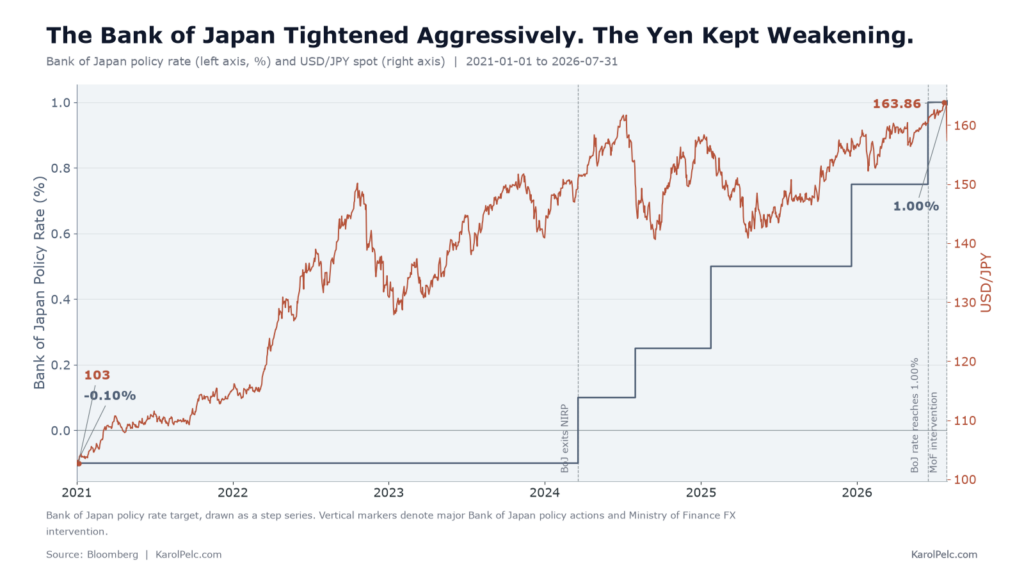
The Japanese yen has undergone one of the largest and most persistent depreciations of any major currency in the post-Bretton Woods era. Since the beginning of 2021, USD/JPY has risen from roughly 103 to a 40-year high of 163.86, equivalent to a depreciation of approximately 37% against the US dollar. During the same period, the Bank of Japan increased its policy rate from –0.10% to 1.00%, its highest level since 1995, ended negative interest rates, abandoned Yield Curve Control and began withdrawing from one of the most accommodative monetary regimes in modern history. Yet the currency continued to weaken. That apparent contradiction is the central question of this paper.
The conventional explanation, that Japanese interest rates remained below US rates, is correct but incomplete. The US–Japan policy-rate gap remains approximately 275 basis points, while the two-year yield differential, the market’s preferred measure of carry, has narrowed materially from its 2024 peak but still stands near 280 basis points. The persistence of yen weakness despite substantial spread compression suggests that USD/JPY has evolved beyond a simple interest-rate differential trade. Investors are increasingly pricing not only carry, but also the credibility of future BoJ tightening, Japan’s structural capital flows, fiscal constraints and the growing likelihood of official intervention.
The distinction matters because it fundamentally changes how the currency should be analysed. For much of the past decade, the yen functioned primarily as a funding currency, with its value reflecting relative monetary policy stances. Today it increasingly reflects whether markets believe Japan can complete monetary normalisation without destabilising government finances, the JGB market, domestic balance sheets or economic growth. In other words, investors are no longer pricing only the exchange rate – they are increasingly pricing the sustainability of the funding regime it represents.
This evolution has consequences far beyond foreign exchange. The yen is no longer simply one of the world’s major currencies; it has become one of its principal funding currencies. As a result, changes in its expected path influence not only currency markets but also global leverage, asset allocation and financial conditions. A gradual depreciation can persist while the underlying funding regime remains intact. A credible shift in policy expectations, by contrast, has the potential to trigger a disproportionately large appreciation because the accumulated stock of leveraged short-yen positions extends far beyond what is visible in conventional positioning data. The principal risk for global portfolios is therefore increasingly asymmetric.
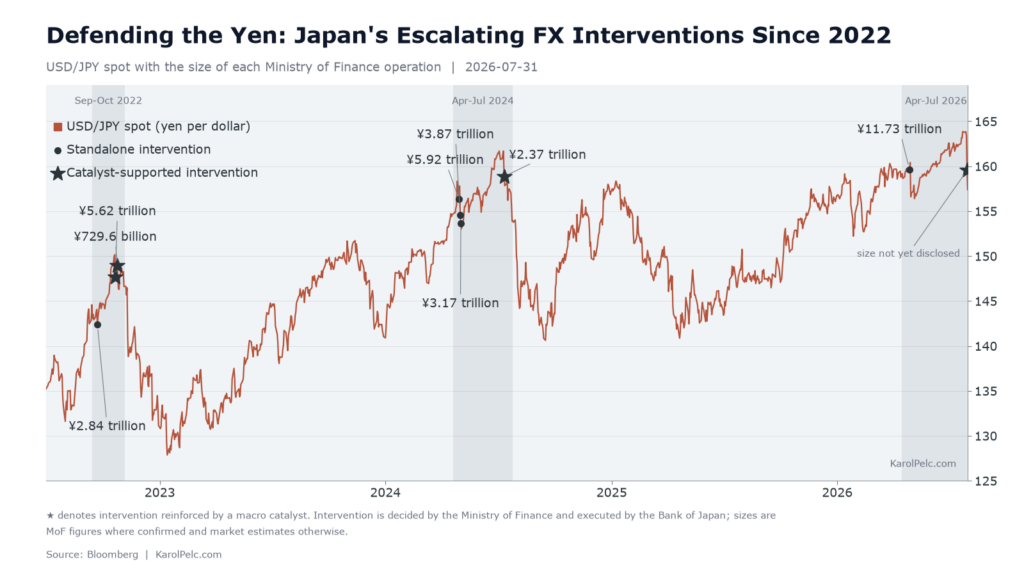
Official intervention reflects the same asymmetry. Since 2022, Japan has repeatedly demonstrated that it can generate an immediate appreciation of three to five yen through large-scale foreign exchange operations. None of the standalone interventions, however, produced a durable change in trend. Lasting reversals occurred only when intervention coincided with a broader macro catalyst, including lower US yields following the October 2022 CPI surprise or the combination of BoJ tightening and a global carry unwind in July 2024. Intervention can alter market dynamics and buy time for fundamentals to evolve, but it cannot eliminate the structural incentives underpinning the funding regime.
July 2026 may nevertheless represent an important inflexion point. The policy environment differs meaningfully from previous episodes: the BoJ has already raised rates to 1.00%; speculative positioning has reached record short-yen exposure; exchange-rate pass-through into domestic inflation has strengthened materially; reported US operational support suggests greater policy coordination; and monetary policy on both sides of the Pacific has become increasingly data-dependent. None of these developments guarantees a structural reversal, but together they increase the probability that intervention could once again coincide with a genuine macro catalyst rather than acting in isolation.
This paper is therefore not an attempt to forecast the next move in USD/JPY. It argues that the more important question is whether one of the world’s most important sources of inexpensive global funding is beginning to change. Understanding that transition requires looking beyond interest-rate differentials to the broader interaction between monetary policy, capital flows, policy credibility and portfolio construction. The implications extend well beyond foreign exchange. They reach into the pricing of leverage, the allocation of capital and, ultimately, the functioning of global financial markets.
The Yen Is No Longer Japan’s Story. It Is a Global Funding Condition
The Japanese yen attracts remarkably little attention for a currency that quietly underpins a significant share of global financial leverage. Japan accounts for less than 4% of global GDP and roughly 6% of global equity market capitalisation, yet the influence of its currency extends far beyond the size of its domestic economy. That influence stems not from trade, economic output or reserve-currency status, but from a financial role that has evolved over more than three decades. The yen has become one of the world’s principal funding currencies.
Funding currencies occupy a unique position within the international financial system. Reserve currencies facilitate trade, settlement and the storage of wealth. Funding currencies determine the cost of leverage. Their importance is therefore measured less by the volume of international transactions they support than by the amount of risk they finance. Changes in their expected path influence not only foreign exchange markets but also portfolio construction, capital allocation and financial conditions across virtually every asset class.
This distinction is fundamental because investors rarely borrow yen to invest in Japan. They borrow yen to invest elsewhere. For more than two decades, exceptionally low Japanese interest rates made the yen one of the least expensive and most predictable sources of financing available anywhere in the world. Borrowed funds were converted into higher-yielding currencies and deployed across equities, sovereign bonds, credit, emerging markets, private markets and countless relative-value strategies. Over time, what began as a conventional carry trade became embedded within the balance sheets of hedge funds, banks, insurance companies, pension funds, sovereign wealth funds and multinational corporations.
The visible foreign exchange position represents only a fraction of this exposure. Much of today’s yen-funded leverage exists in cross-currency swaps, derivatives, securities financing transactions, and prime broker balance sheets rather than in outright currency positions. The size of the global funding ecosystem therefore cannot be inferred from speculative positioning alone. The yen has become part of the financial system’s infrastructure rather than simply another traded asset.
This transformation fundamentally changed the role of the exchange rate. Most currencies are analysed as outcomes of macroeconomic conditions. They reflect differences in inflation, interest rates, productivity, trade balances and capital flows between two economies. The yen increasingly occupies a different role. It has become one of the mechanisms through which global financial conditions are transmitted. Rather than merely responding to changes in monetary policy, it increasingly influences the cost of capital supporting global investment portfolios.
During the deflation era, policymakers could tolerate substantial currency depreciation because exchange-rate pass-through into consumer prices remained limited. That relationship has changed materially. Japanese firms have become increasingly willing to pass higher import costs to consumers, making the exchange rate a far more important determinant of inflation and real household incomes. Currency weakness, therefore, carries greater monetary policy implications than in previous decades.
That distinction changes how investors should interpret currency movements. A persistently weak and stable funding currency lowers financing costs, compresses risk premia and encourages investors to employ larger balance sheets. Cheap funding expands the opportunity set for leveraged strategies, increases demand for higher-return assets and supports richer valuations across markets. These effects develop gradually and are rarely attributed to the funding currency itself because they become embedded within portfolio construction over time.
The adjustment works differently once the funding currency begins appreciating. Investors no longer face only higher financing costs. They also incur mark-to-market losses on the funding leg itself. A position originally established to earn positive carry can therefore begin losing money simultaneously through rising borrowing costs and an appreciating currency. What initially appears to be a foreign exchange move rapidly becomes a balance-sheet event.
The first response is rarely wholesale asset liquidation. It is balance-sheet management. Hedge funds reduce gross exposure to preserve risk budgets. Prime brokers tighten financing conditions and increase collateral requirements. Dealers allocate less balance-sheet capacity to leveraged transactions. Volatility-targeting and risk-parity strategies mechanically reduce exposure as realised volatility rises and cross-asset correlations increase. These adjustments occur regardless of whether investors have changed their views on economic fundamentals. They reflect changes in financing conditions rather than changes in valuation.
This mechanism explains why funding shocks often produce unusually high correlations across otherwise unrelated asset classes. Assets with little direct connection to Japan begin moving together because they share a common source of leverage. During periods of abundant funding, these relationships remain largely invisible. During periods of funding stress, they become one of the dominant drivers of market behaviour.
Equity markets illustrate the process particularly well. Companies whose valuations depend heavily on abundant liquidity and long-duration cash flows benefit disproportionately from inexpensive funding. Technology, semiconductors, AI infrastructure and other high-growth sectors have therefore been indirect beneficiaries of the global funding regime supported by the yen. A sustained appreciation of the currency would not necessarily alter their earnings outlook immediately, but it could materially tighten the financial conditions under which those valuations were established.
Credit markets exhibit similar dynamics. Funding shocks rarely begin as credit events, yet they frequently become credit events. Investment-grade spreads widen as dealer balance-sheet capacity contracts, while lower-rated and less-liquid markets experience larger adjustments because financing conditions deteriorate before corporate fundamentals do. The initial repricing reflects the availability of capital rather than the probability of default.
Emerging markets are equally sensitive. For decades, higher-yielding currencies and local bond markets have attracted capital financed in low-yielding funding currencies. As the economics of that funding deteriorate, leveraged positions become less attractive simultaneously. Exchange rates weaken, bond yields rise and capital outflows accelerate even when domestic fundamentals remain broadly unchanged. The catalyst lies not within the recipient economy but within the funding currency itself.
Volatility completes the feedback loop. Stable funding suppresses realised volatility by encouraging leverage and reducing forced transactions. Once funding conditions tighten, the process reverses. Higher realised volatility triggers mechanical deleveraging, which generates further volatility, raises the cost of hedging and reinforces the contraction in risk-taking. Financial conditions tighten not because central banks explicitly withdraw liquidity, but because the private sector becomes less willing or less able to employ leverage.
History repeatedly demonstrates that major market dislocations often originate not from deteriorating economic fundamentals but from changes in financing conditions. The Global Financial Crisis exposed the world’s dependence on US dollar funding. The European sovereign crisis revealed the importance of euro funding fragmentation. The next major transition may centre on something different: the gradual normalisation of the world’s largest source of inexpensive funding. If that process continues, the most significant effects are unlikely to appear first in the foreign exchange market. They will emerge through changing leverage, tighter financial conditions and higher correlations across global portfolios.
The market has therefore spent much of the past four years debating the wrong question. The issue is not whether USD/JPY should trade at 150, 155 or 160. The more important question is whether one of the world’s largest and longest-standing funding regimes is beginning to change. If it is, the exchange rate will simply be the first observable symptom of a much broader repricing across international financial markets.
Understanding how that funding regime emerged requires looking back more than three decades. The yen did not become the world’s principal funding currency through deliberate strategy or international agreement. It became one as the unintended consequence of Japan’s prolonged fight against deflation. That story begins with the collapse of the country’s asset bubble in the early 1990s.
How Japan Created the World’s Funding Currency
The yen did not become one of the world’s principal funding currencies through deliberate strategy or international agreement. It emerged as the unintended consequence of more than three decades of monetary policy aimed at solving a domestic economic problem. Policies introduced to combat deflation, stimulate demand and stabilise the banking system gradually transformed Japan into the provider of the world’s cheapest source of capital.
The story began with the collapse of Japan’s asset bubble in the early 1990s. Equity and real estate prices fell sharply, banks were burdened with impaired balance sheets, and the economy entered a prolonged period of weak growth, deleveraging and persistent deflation. Conventional monetary policy quickly reached its limits. By 1999, the Bank of Japan had reduced short-term interest rates to effectively zero, becoming the first major central bank to adopt what later became known as the Zero Interest Rate Policy (ZIRP).
What was initially introduced as an emergency measure gradually evolved into a permanent policy framework. Quantitative easing followed in 2001, substantially expanding the Bank of Japan’s balance sheet. The Global Financial Crisis reinforced the need for extraordinary accommodation, while the launch of Abenomics in 2013 accelerated monetary expansion through Quantitative and Qualitative Easing (QQE). Three years later, Japan introduced negative interest rates and Yield Curve Control (YCC), committing to maintain exceptionally low government bond yields through potentially unlimited purchases of Japanese government bonds.
Each measure was introduced to address a domestic challenge. Collectively, however, they produced a global consequence.
While interest rates elsewhere continued to move through normal economic cycles, Japanese funding costs remained anchored close to zero for almost three decades. Investors gradually stopped viewing low Japanese borrowing costs as a cyclical opportunity and instead began treating them as a structural feature of global financial markets. That distinction proved critical. Temporary market anomalies attract capital. Permanent market structures reshape portfolio construction.
The effects became increasingly visible within Japan itself. Pension funds, life insurers, banks and asset managers struggled to achieve acceptable returns in an environment where domestic government bonds offered little or no yield. As a result, they steadily increased their allocations to overseas assets, becoming among the world’s largest holders of foreign sovereign bonds, corporate credit, and international equities. Japanese capital increasingly financed growth abroad rather than at home.
International investors reached the opposite conclusion. Instead of investing in Japan, they increasingly borrowed in yen to finance investments elsewhere. The combination of exceptionally low funding costs, deep market liquidity and relatively stable exchange-rate behaviour made the yen uniquely attractive as a financing currency. Over time, borrowing yen became less a tactical trade and more a structural feature of global portfolio management.
The longer this environment persisted, the more deeply it became embedded in the financial system. Cheap funding supported not only traditional carry trades but also relative-value strategies, merger arbitrage, convertible-bond arbitrage, macro trading, private-market investments and a growing range of leveraged investment strategies. Much of this exposure no longer appeared as an explicit currency position. Instead, the funding leg became embedded within derivatives, cross-currency swaps, securities-financing transactions and institutional balance sheets. By the early 2020s, the yen had become part of the plumbing of global finance.
Ironically, the success of Japan’s domestic policy increased the world’s dependence upon it. Every additional year of exceptionally low interest rates reinforced the assumption that inexpensive yen funding would remain permanently available. Investors gradually stopped treating funding as an active investment decision because it had become one of the most predictable inputs into portfolio construction. Like many structural assumptions in financial markets, its importance became least visible precisely when confidence in it was greatest.
This distinction helps explain why the post-pandemic inflation shock proved so consequential. When inflation accelerated globally after 2021, most central banks responded with the fastest synchronised tightening cycle in decades. Japan faced a far more complex challenge. Raising interest rates no longer meant simply adjusting monetary policy. It meant beginning to dismantle a funding regime that global investors had come to rely upon for more than thirty years.
The Bank of Japan therefore entered the tightening cycle from a fundamentally different starting point than any other major central bank. The Federal Reserve, the European Central Bank and the Bank of England needed to slow domestic demand. Japan needed to normalise policy without destabilising a financial architecture that had gradually evolved around the assumption of permanently inexpensive funding.
That distinction would prove decisive. Rather than strengthening as monetary policy normalised, the yen entered one of the largest and most persistent depreciations in modern history. Understanding why requires examining not only what the Bank of Japan did, but also how global investors interpreted its ability to complete the normalisation process.
The Great Divergence
The return of inflation after the pandemic confronted every major central bank with the same challenge: restore price stability without triggering a deep recession. The response, however, differed dramatically across economies. While the Federal Reserve implemented the fastest tightening cycle in four decades, the Bank of Japan remained the final major central bank committed to extraordinary monetary accommodation. The resulting divergence produced one of the largest interest-rate differentials in modern history and accelerated the yen’s transformation into the world’s preferred funding currency.
Between early 2022 and late 2023, the Federal Reserve increased its policy rate from effectively zero to 5.50%, while the Bank of Japan maintained negative interest rates and Yield Curve Control. The US–Japan policy-rate differential widened to approximately 565 basis points, while the two-year government bond spread, arguably the most relevant measure for currency funding, approached 500 basis points. At those levels, remaining long yen imposed a substantial opportunity cost. Investors no longer needed to believe the currency would weaken. They merely needed to believe it would not appreciate sufficiently to offset the positive carry available elsewhere.
Monetary policy was only part of the story. Russia’s invasion of Ukraine triggered a sharp deterioration in Japan’s terms of trade as energy and commodity imports surged. Unlike the United States, Japan remained heavily dependent on imported energy, increasing demand for foreign currency precisely when widening interest-rate differentials were already encouraging capital to leave the country. Monetary divergence and external trade dynamics therefore reinforced one another, producing one of the most persistent episodes of yen depreciation in the post-Bretton Woods era.
By late 2022, the depreciation had become politically unacceptable. The Ministry of Finance intervened for the first time since 1998 after USD/JPY breached 145, followed by a second intervention one month later as the exchange rate approached 152. Yet the underlying trend remained unchanged. Markets correctly recognised that official intervention could influence short-term market dynamics but could not eliminate the structural incentive to finance global portfolios in yen.
The turning point appeared to arrive in 2024. Inflation became more firmly embedded within the Japanese economy, wage growth strengthened, and the Bank of Japan finally began dismantling the monetary framework that had defined the previous decade. Negative interest rates were abolished, Yield Curve Control was progressively abandoned, and policy rates began rising for the first time since 2007. By June 2026, the policy rate had reached 1.00%, its highest level since 1995.
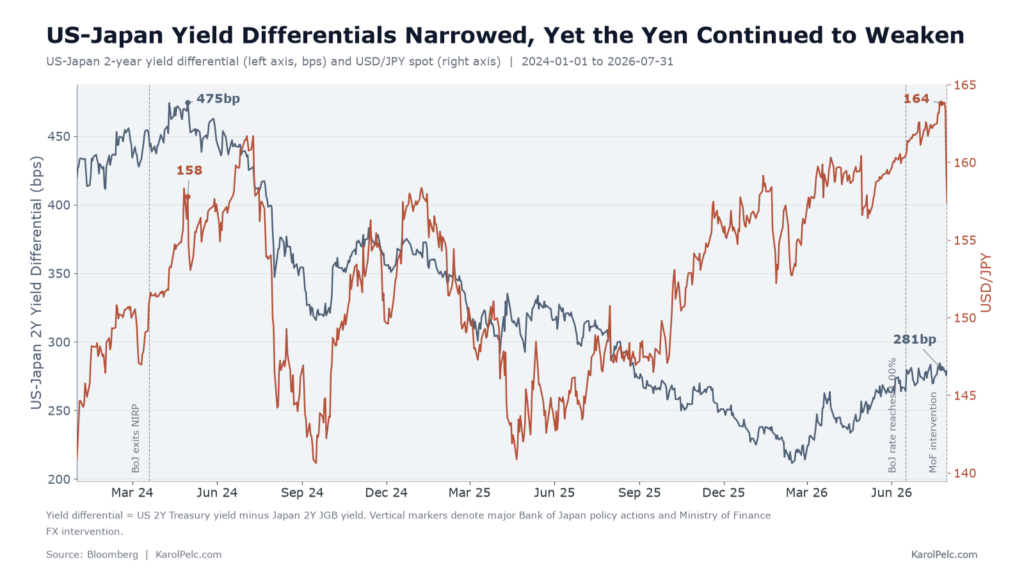
Conventional macroeconomic theory would suggest that such a profound policy reversal should have supported the currency. Instead, USD/JPY continued to appreciate, ultimately reaching a 40-year high of 163.86 in July 2026 because markets were not pricing in the Bank of Japan’s tightening; they were pricing in where that tightening was likely to end. A central bank can deliver the largest hiking cycle in decades and still fail to strengthen its currency if investors conclude that the terminal policy rate remains too low to alter the long-run economics of global capital allocation. That was the market’s assessment of Japan.
Although the Bank of Japan increased its policy rate by 110 basis points, markets simultaneously concluded that the scope for additional tightening remained constrained. Public debt exceeding 200% of GDP, a government bond market shaped by years of central bank purchases, and a domestic financial system adapted to exceptionally low borrowing costs all limited expectations regarding the ultimate destination of policy. The question was no longer whether the Bank of Japan was tightening. It was whether it could tighten enough.
The same logic applied to capital flows. Japan continued to generate sizeable current-account surpluses, but an increasing proportion of them reflected investment income earned on foreign assets rather than merchandise exports. Much of that income remained overseas, while Japanese pension funds, insurers, corporations and households continued allocating savings internationally. The current account therefore appeared supportive of the yen in aggregate statistics while generating considerably less immediate demand for the currency than traditional exchange-rate models would imply.
At the same time, the economics of the funding trade remained intact. Even after the Bank of Japan’s tightening cycle, the US–Japan policy-rate differential remained approximately 275 basis points, while the two-year spread remained close to 280 basis points. Borrowing costs had undoubtedly increased, but not enough to fundamentally alter the attractiveness of financing global portfolios in yen. The funding regime had become less favourable than during its peak, but it had not become unattractive.
The exchange rate therefore came to reflect something broader than relative interest rates alone. Investors were effectively pricing the credibility of the entire normalisation process. Could Japan restore conventional monetary policy without materially increasing debt-servicing costs? Could government bond yields normalise without destabilising the JGB market? Could interest rates rise meaningfully without undermining domestic growth or financial stability? As long as those questions remained unresolved, each incremental rate increase conveyed less information than the market’s estimate of when the tightening cycle would end.
This explains why the relationship between yield differentials and the exchange rate gradually weakened. Narrowing spreads remained a necessary condition for sustained yen appreciation, but they were no longer sufficient. Investors had begun pricing not only today’s policy settings but also the credibility of tomorrow’s policy regime.
That distinction transformed the investment debate. The question was no longer whether the yen was fundamentally undervalued or whether another 25 basis-point rate increase would strengthen the currency. The more important question became whether the financial architecture built around three decades of inexpensive funding could survive a gradual return to positive interest rates.
History suggests that exchange rates rarely change sustainably because policymakers want them to. They change when the incentives facing private capital shift.
That observation also explains the mixed record of foreign-exchange intervention. Japan has repeatedly demonstrated that it can move the exchange rate. What it has not yet demonstrated is an ability to alter the economic incentives underpinning the funding regime itself.
That distinction is the foundation of the next chapter.
Intervention Cannot Replace Fundamentals
Foreign-exchange intervention is often portrayed as an attempt to defend a currency. In practice, it serves a different purpose. Intervention cannot permanently determine the equilibrium value of the yen, but it can alter market behaviour by disrupting positioning, increasing uncertainty and buying time for macroeconomic fundamentals to evolve. Whether those effects persist depends less on the size of the intervention than on the environment into which it is deployed.
The empirical evidence from recent years is remarkably consistent. Every intervention since 2022 generated an immediate appreciation of the yen. None of the standalone operations produced a lasting reversal in trend. Durable appreciation occurred only when official action coincided with a broader shift in the macroeconomic backdrop.
| Intervention |
Initial yen appreciation |
After 2 weeks | After 4 weeks | Trend outcome | Fundamental driver |
|---|---|---|---|---|---|
| 22 Sep 2022 | ¥1.7 | Fully reversed | Fully reversed | Temporary | None |
| 21 Oct 2022 | ¥2.5 | Effect sustained | Effect sustained | Durable | US CPI downside surprise and lower Treasury yields |
| 29–30 Apr 2024 | ¥5.3 | Mostly reversed | Mostly reversed | Temporary | None |
| Jul 2024 | ¥2.9 | Appreciation extended | Appreciation sustained | Durable | BoJ tightening and broader carry-trade unwind |
| 30 Apr 2026 | ¥3.8 | Mostly reversed | Mostly reversed | Temporary | None |
| 30–31 Jul 2026 | ¥4.3 | Ongoing | Ongoing | Developing | Policy coordination and macro backdrop still evolving |
The September 2022 intervention provides the clearest example. After USD/JPY breached 145, Japanese authorities entered the market for the first time since 1998, generating an immediate appreciation of almost two yen. Within days, however, the currency resumed weakening as the underlying interest-rate differential remained largely unchanged. Intervention temporarily altered liquidity conditions but did not change the economics of financing global portfolios in yen.
The October 2022 episode reached a different outcome because the macro environment changed almost immediately afterwards. The intervention itself again produced only a modest appreciation, but the subsequent downside surprise in US inflation triggered a broad repricing of Federal Reserve expectations. Treasury yields declined sharply, interest-rate differentials narrowed, and USD/JPY fell from around 150 to below 138 over the following weeks. The intervention did not cause the sustained appreciation; it bridged the market until fundamentals changed.
The same pattern emerged in 2024. Japan’s largest-ever confirmed intervention temporarily reversed the depreciation, but the exchange rate gradually recovered as investors rebuilt carry positions. Only the July intervention proved durable because it coincided with a Bank of Japan rate increase and a broader unwinding of leveraged carry trades. Once again, intervention succeeded not because it overwhelmed market forces, but because it reinforced them.
April 2026 returned to the earlier pattern. Despite an operation estimated at more than ¥5 trillion, speculative positioning rebuilt rapidly and USD/JPY resumed its upward trend. Markets interpreted the intervention as a temporary interruption rather than evidence that the underlying funding regime had changed.
Taken together, these episodes point to a simple conclusion. Intervention changes prices. Fundamentals change trends.
That distinction explains why intervention appears progressively less effective over time. As investors gain confidence that official action will remain temporary, episodes of forced appreciation increasingly become opportunities to rebuild short-yen positions at more attractive entry levels. The Ministry of Finance is therefore attempting to counter a structural funding regime using a tactical policy instrument. Unless the underlying economics of the funding trade change, intervention merely alters the timing of the adjustment rather than its direction.
July 2026 may nevertheless represent an important departure from previous episodes because the intervention occurred as several of those structural forces were beginning to shift simultaneously. Unlike earlier operations, it followed the largest Bank of Japan tightening cycle in more than three decades, a meaningful narrowing in US–Japan yield differentials and a growing recognition that exchange-rate depreciation was feeding more directly into domestic inflation. At the same time, speculative short-yen positioning had reached record levels, while reports that the New York Federal Reserve conducted rate checks on behalf of Japanese authorities suggested a degree of operational coordination rarely seen in previous interventions.
Individually, none of these developments guarantees a sustained appreciation of the yen. Collectively, however, they make July 2026 fundamentally different from earlier episodes. Previous interventions attempted to slow depreciation while the underlying economics remained overwhelmingly supportive of the funding regime. This time, intervention occurred alongside a macroeconomic backdrop that may itself be evolving. The significance of July 2026 therefore lies less in the size of the operation than in the possibility that, for the first time since the post-pandemic depreciation began, official action coincided with a genuine change in the incentives facing global capital.
Whether that proves sufficient to alter the long-term trajectory of the yen remains uncertain. What is increasingly clear, however, is that investors should evaluate intervention differently. The relevant question is no longer whether authorities can move the exchange rate for a day or a week – they clearly can. The more important question is whether the forces supporting three decades of inexpensive yen funding are beginning to weaken.
If the answer is yes, the implications extend well beyond foreign exchange. The repricing will not be confined to USD/JPY. It will gradually be transmitted through the cost of leverage into equities, credit, sovereign bonds and broader financial conditions.
Investing for a New Funding Regime
The central conclusion of this paper is not that the yen is destined to strengthen. It is that one of the world’s most important funding regimes may be entering a period of structural transition. That distinction matters because investment outcomes will depend less on the absolute level of USD/JPY than on whether the assumptions underpinning three decades of inexpensive Japanese funding continue to hold.
The base case remains one of gradual normalisation rather than abrupt regime change. The Bank of Japan is likely to continue tightening, but at a pace that balances inflation risks against financial stability and fiscal sustainability. At the same time, the Federal Reserve appears increasingly data-dependent, reducing the likelihood that US–Japan interest-rate differentials widen materially from current levels. Under this scenario, the economics of yen-funded carry gradually become less attractive without disappearing altogether. The adjustment is therefore more likely to be evolutionary than disruptive.
A more constructive outcome for the yen would require accelerated policy convergence. That could occur through a combination of additional Bank of Japan tightening, softer US inflation, lower US policy expectations or stronger domestic wage growth in Japan. The significance of such a scenario extends beyond the exchange rate itself. A sustained compression in funding differentials would gradually reduce the attractiveness of leveraged carry strategies, encouraging balance-sheet contraction across parts of the global financial system. The adjustment would probably begin in funding markets before becoming visible across broader asset prices.
The principal downside risk is that policy convergence stalls. Should US inflation remain persistent while Japanese inflation moderates, interest-rate differentials could stabilise at historically elevated levels. In that environment, the economics of yen-funded carry would remain largely intact, encouraging investors to rebuild short-yen positions after each episode of official intervention. The exchange rate could continue to weaken despite periodic policy action, reinforcing the pattern observed since 2022.
A less probable but more consequential scenario is one in which the funding regime itself becomes unstable rather than simply expensive. The interaction between higher interest rates, elevated public debt, and a government bond market still adjusting to reduced central bank support could generate periods of materially higher volatility in both Japanese fixed-income and foreign-exchange markets. Such an outcome would represent a funding shock rather than a conventional currency move, increasing correlations across asset classes and placing liquidity ahead of valuation as the dominant driver of market behaviour.
These scenarios suggest that investors should devote less attention to predicting individual exchange-rate levels and more attention to monitoring the conditions that determine whether the funding regime is changing. The exchange rate itself is often the final variable to move. Expectations, positioning and funding conditions typically adjust first.
Several indicators therefore deserve close attention.
First, the US–Japan two-year yield differential remains the single most informative market-based measure of the incentive to fund global portfolios in yen. Continued compression would signal that the economics of the carry trade are becoming less compelling, while renewed widening would reinforce the existing funding regime.
Second, expectations regarding the Bank of Japan’s terminal policy rate matter more than the next individual rate decision. Financial markets consistently price where policy is expected to end rather than the direction of travel. Evidence that investors are revising their estimate of Japan’s long-run policy rate upward would carry greater implications for the yen than another incremental increase that leaves terminal expectations unchanged.
Third, Japanese wage growth and core inflation should be viewed together rather than in isolation. Sustainable wage growth increases the likelihood that inflation remains domestically generated rather than imported, strengthening the case for continued monetary normalisation and improving the credibility of the policy path.
Fourth, positioning and market structure deserve at least as much attention as macroeconomic data. Record speculative short-yen positions, rising implied volatility, widening cross-currency basis swaps and tightening prime-broker financing conditions often provide earlier signals of stress than economic releases. Funding regimes rarely unravel because investors change their forecasts simultaneously. They unravel because balance sheets become increasingly constrained.
Taken together, these indicators reinforce a broader point. The next phase of the yen’s evolution is unlikely to be driven by any single policy announcement or intervention. It will emerge from the interaction among monetary policy, market expectations, and portfolio positioning. The transition, if it occurs, is likely to be gradual until it is suddenly not—a characteristic common to many structural changes in financial markets.
The investment implication is therefore broader than foreign exchange. Investors with exposure to long-duration growth equities, private assets, credit or highly leveraged strategies should increasingly treat the yen as an indicator of global financial conditions rather than simply another currency within a diversified portfolio. The most important signal may not be whether the yen strengthens by five or ten per cent, but whether its role as the world’s cheapest source of capital begins to diminish.
The market has spent much of the past four years debating whether the yen is fundamentally too weak. That debate, while understandable, is ultimately incomplete. The more important question is whether one of the defining assumptions underpinning global asset prices—the availability of abundant, inexpensive Japanese funding—is beginning to change.
If that assumption proves durable, the consequences for global markets will remain limited. If it does not, the exchange rate will simply become the first visible symptom of a much broader repricing. Funding costs will rise, leverage will contract, correlations across asset classes will increase, and liquidity will once again command a premium.
The Japanese yen is therefore no longer simply a currency to be analysed within the foreign-exchange market. It has become one of the clearest windows into the evolution of global financial conditions. That, more than the precise level of USD/JPY, is the development investors should be watching over the coming years.